SAP S/4HANA Service
Your Path to a Modern Service Business
Take advantage of the transition to SAP S/4HANA Service to strategically grow your service business. proaxia supports you every step of the way—from assessing your current situation to defining your target architecture and implementing the solution—while integrating business service processes with technical execution and your field service team.
What is SAP S/4HANA Service?

SAP S/4HANA Service supports the commercial and operational management of your service business. This includes, among other things, service contracts, service quotes, service orders, completion reports, and billing. Integrated processes link these tasks to materials management, procurement, and finance—from the agreed-upon scope of services to financial analysis.
This solution is the strategic successor to the classic SAP Customer Service, or SAP CS for short. However, it is not simply a new user interface for that system: SAP S/4HANA Service uses its own data model and new business service objects. This transition therefore opens up the opportunity to realign not only your technology but also your processes and your service offerings.
What value does SAP S/4HANA Service add to your service business?
The available features depend on the edition, release, licensing, and technical requirements. In particular, AI features are not universally available in every operating mode.
Migration from SAP CS to SAP S/4HANA Service
A successful transition to the ERP platform does not necessarily mean that your service business has already been modernized.
Companies can be live on SAP S/4HANA and still continue to use classic SAP CS within the limited compatibility scope. The technical conversion and the implementation of SAP S/4HANA Service should therefore be considered separately. The key factor is how you intend to sell, plan, execute, and bill for services in the future.

Different Starting Points – Targeted Planning
Your Path to Transformation—Redesign, Restructure, Improve

The right path to SAP S/4HANA Service depends on your current situation and your business goals. You can fundamentally redesign your service processes and architecture, or migrate proven workflows into the new solution while staying as close to the original processes as possible. Both approaches lead to a common goal after go-live: continuously improving your service business. A hybrid approach may be advisable if, for example, individual subsidiaries have different requirements.
Redesign: Realigning Processes and Architecture
With this approach, you define your future service business based on business requirements. You design service processes, restructure data and responsibilities, and plan the necessary integrations.
In the architecture shown, this is the path to a fresh start with SAP Cloud ERP, specifically the Public Edition. A redesign is also an option for SAP Cloud ERP Private and SAP S/4HANA On-Premise.
The central question is: What processes will you need in the future—and which historically developed structures can you simplify?
Lift & Shift: Targeted Migration of Proven Processes
For existing SAP CS environments in SAP Cloud ERP Private or SAP S/4HANA On-Premise, a process-oriented migration may be advisable. In this approach, the new solution is based on proven service workflows, while necessary changes are implemented in a targeted manner.
However, “Lift & Shift” does not mean a 1:1 copy of the existing system without any changes. The new data model and business service objects require a business and technical evaluation. In-house developments, interfaces, and open business processes must therefore be specifically taken into account.
The goal is a controlled transition in which necessary changes are implemented and further optimizations are then introduced step by step.
Improve: Continue targeted development after the go-live
The next phase begins with the go-live. You’ll assess which additional features effectively complement your existing service processes, where automation can reduce your workload, and how new SAP releases fit into your service landscape.
Modern user interfaces, integrated analytics, and new service offerings can open up further opportunities for growth. Your priorities should be guided by the benefits for your employees, your customers, and the profitability of your service business.
Consider in-house developments and integrations from the very beginning
Regardless of the transformation path, individual extensions and interfaces must be evaluated. What requirements does the standard cover? Which extensions remain necessary? And which dependencies can be reduced?
The Clean Core philosophy thus guides the entire transformation: rather than continuing every previous adaptation unchanged, we implement necessary enhancements using appropriate extension mechanisms and systematically reduce accumulated complexity.
Why proaxia?
Why switch to SAP S/4HANA Service now?
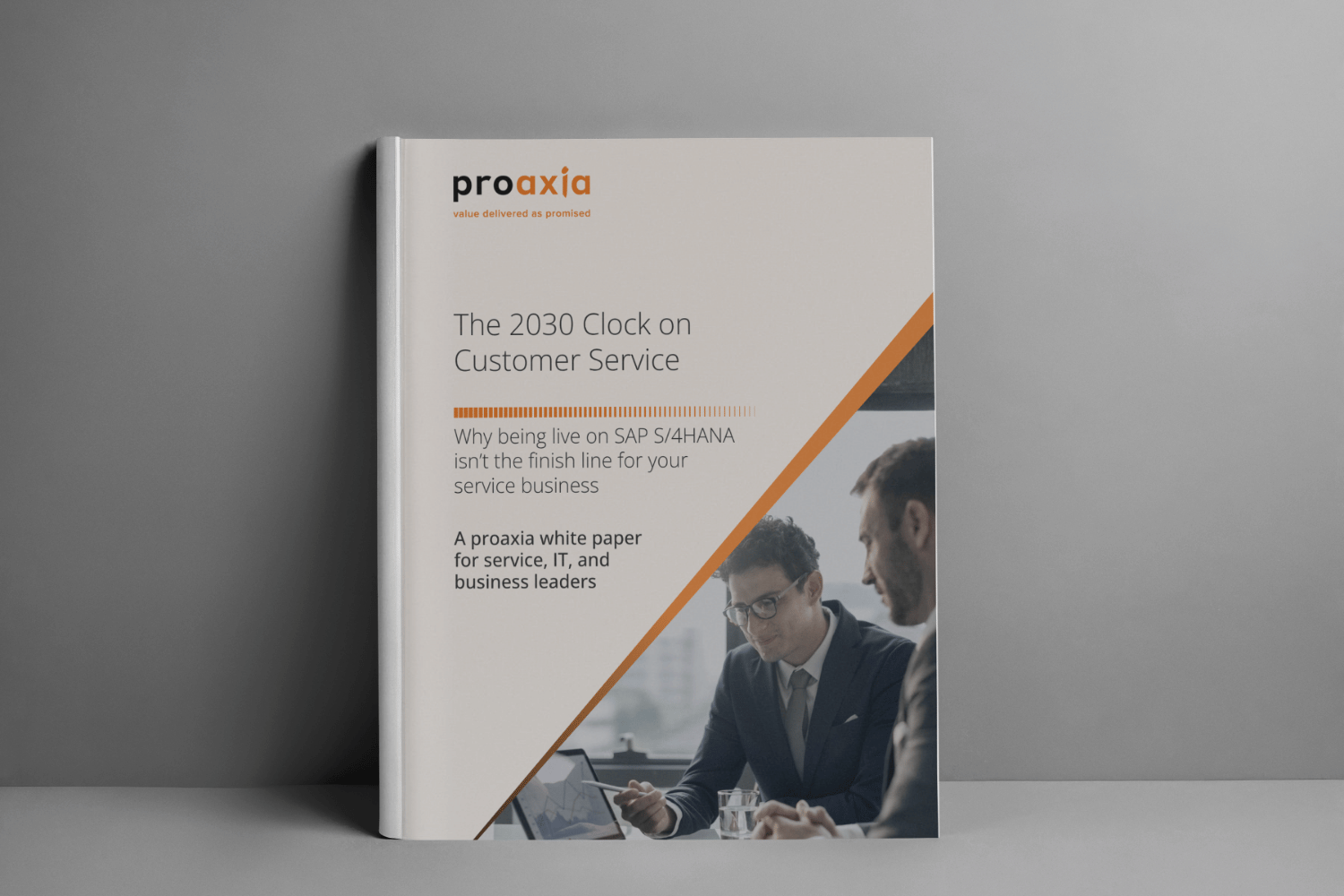
Don’t wait until the very last minute to shape your future service business. Planning early on creates room for clear decisions, data preparation, testing, and the involvement of your employees. The proaxia white paper cites an average timeframe of 12 to 24 months for service transformation projects; cross-border rollouts may take longer.
Understanding Deadlines Correctly
For your planning, you must distinguish between the maintenance periods for existing SAP products and the time-limited usage rights within the Compatibility Scope.
| Background | Time Frame |
|---|---|
| Classic SAP CS in the Compatibility Scope on SAP S/4HANA On-Premise | For CS, the special deadline generally applies until December 31, 2030. |
| Classic SAP CS under the applicable cloud subscription terms and conditions | Use may be permitted through December 31, 2033. This deadline does not apply uniformly to every SAP CS installation; the specific terms of the contract are decisive. |
| SAP ECC and SAP CRM within the covered Business Suite 7 releases | SAP specifies Mainstream Maintenance through the end of 2027 and optional, fee-based Extended Maintenance through the end of 2030. |
The Compatibility Scope is not a permanent operating option. Once the applicable term expires, the corresponding contractual right of use ceases—regardless of whether the SAP S/4HANA release in use is still being supported. You should therefore check early on which provisions apply to your system landscape.
Creative Freedom Instead of Deadline Pressure
By assessing your current situation early on, you can prioritize processes, define responsibilities, and align the transformation with other initiatives. Rather than simply replacing existing functions, you create space to consider how your service business should operate and grow in the future.
Don’t Put Off Business Benefits
The deadline is a catalyst for transformation, but it is not its only benefit. Further developing your service landscape can also lead to greater financial transparency, modern work interfaces, and new opportunities for recurring services. These potential benefits should be factored into your decision just as much as the technical need for action.
In-Depth: The 2030 Deadline for Customer Service
Discovery Workshops: Your Introduction to the S/4HANA Service Transformation
With the proaxia SAP S/4HANA Service Discovery Workshops, you’ll lay the groundwork for your next step—from a business, technical, and organizational perspective.

The subsequent implementation is based on SAP Activate and the “Fit-to-Standard” approach: Standard processes serve as the starting point, and any necessary deviations are evaluated on a case-by-case basis.
The outcome of your workshop series “
” is a coordinated target vision, a clearly defined scope of transformation, and an implementation plan tailored to your company—serving as the foundation for your next decisions.
Frequently Asked Questions About SAP S/4HANA Service
Take the Next Step Toward SAP S/4HANA Service
What does the right transformation path look like for your company?
Assess your current situation, define your target state, and lay the groundwork for a robust roadmap. With proaxia, you can combine the replacement of SAP CS with the strategic growth of your service business.