Car Dealer Software
The key to efficient automotive business management

The automotive industry is changing rapidly. Diverse business models, new brands entering the market, rising customer expectations with declining loyalty and growing competitive pressure, combined with margin erosion due to electromobility, present car dealerships with major challenges. In this environment, modern Car Dealer Software or a Dealer Management System (DMS) becomes the central basis for sustainable success.
But what exactly makes a DMS so important – and what real business value does it offer?
What is car dealer software?
Classic car dealership software supports the central, specific processes of the automotive trade. This is often supplemented by specialized stand-alone solutions for sub-processes that are integrated with financial accounting software. It is not uncommon for several solutions to be used for different brands and to ensure integration with the manufacturers. The data from the various solutions is exported to analysis solutions in order to obtain key figures for corporate management.
Modern car dealer software is much more than classic car dealership software. It is the dealership’s central business platform for effective and efficient processes in day-to-day business. It also controls all business processes in the dealership at an operational and strategic level. The platform combines customer-oriented processes in sales, service, rental, parts management and overarching customer interaction. It also manages administrative processes (back office) as well as financial accounting and controlling in a standardized corporate environment.
At its core, modern car dealer software is a comprehensive platform for the automotive trade. It supports dealers in achieving sustainable success in an increasingly complex market environment with ever faster changes in business models.

Why a modern DMS is indispensable today
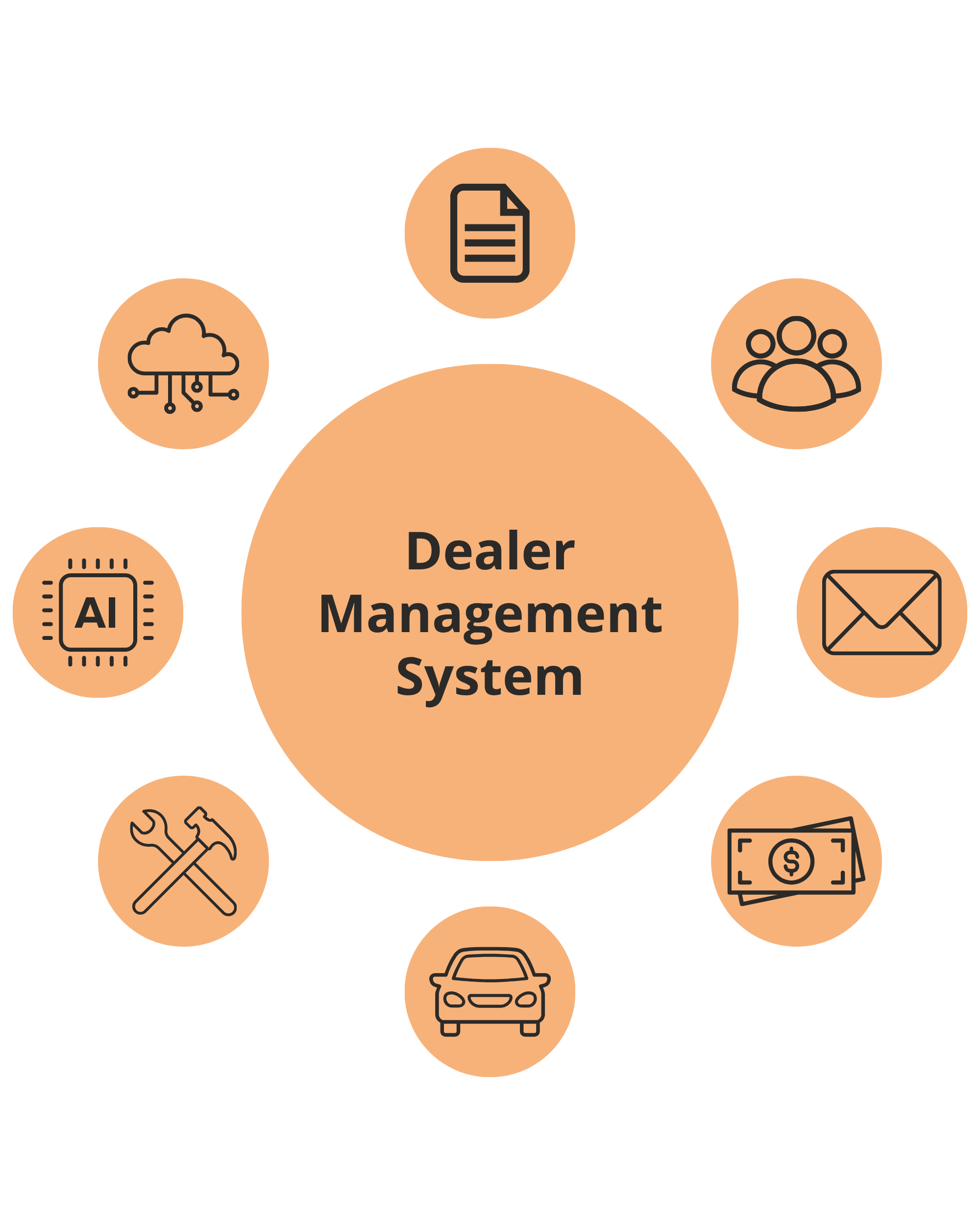
The demands placed on car dealerships are constantly increasing. Customers expect fast processes, personalized offers and seamless digital experiences.
Powerful car dealer software helps to meet these expectations:
Result: Greater efficiency, higher customer satisfaction, stronger customer loyalty, leaner system and increasing sales
End-to-end solution: from lead to service
A decisive advantage of modern DMS systems is the end-to-end approach.
A good dealer management system software covers all of a dealer’s core processes consistently on a common database. Isolated solutions become obsolete:
This shows: All processes are interconnected – and this is where the greatest added value is created.
In addition to end-to-end processes, a good DMS also supports collaboration between departments. It triggers workflow-based follow-up activities in the internal process, as well as communication with the customer. For example, order extension workflows in service can be mapped in a lean and automated way.
In addition to efficient processes, a modern DMS uses all points of contact with the customer, whether online or in person, to provide customized offers and generate additional sales. In this way, DMS and customer management merge into an end-to-end solution that optimizes margins and inspires and retains customers.
Rental in the car trade:
Successfully managing additional business models
Traditional vehicle marketing is increasingly being supplemented by flexible usage models. Rental, leasing and subscription offers are becoming increasingly important in automotive retail.
Modern dealer management software supports this development by fully integrating rental processes:
By integrating rental into a central car dealership software, an additional business model becomes a real sales driver – efficiently managed and completely transparent.

Scalability: growth without system limits
Dealer networks are consolidating in many markets. There are increasingly large, international retail groups in a multi-brand environment. Modern dealer management software must be able to grow with the company. Scalability is crucial, especially for larger organizations:

This scalability makes it possible to quickly integrate new locations or brands into a central system – without complex IT projects.
Business value: faster growth with stable processes and economies of scale.
Automotive Dealership Software on an SAP ERP platform
For many larger and growing retailer groups, integration into existing IT landscapes is a major challenge and a decisive cost factor. System discontinuities result in unnecessary process costs. This is where automotive dealership software on the SAP ERP platform offers a clear advantage.
It links operational processes in the dealership directly with central corporate functions:
The great added value lies in the data consistency and the continuous data flow
All business areas access the same database – without media disruptions or duplicate data entry.
This enables:
The SAP platform also provides a consistent database and the technological basis for AI. SAP Business AI supports streamlined and automated processes with AI-supported analyses, assistants and agents. All of this is audit-proof and auditable, in compliance with regulatory requirements such as GDPR.
This makes the Dealer Management System not only an operational tool, but also a strategic platform for holistic automotive business management and continuous innovation.
Cloud and AI: the future of car dealership software
Cloud technology and artificial intelligence (AI) are the enablers of innovation and optimization for modern dealership solutions.
AI functionalities:
An example:
A voicebot for making service appointments is always available for the customer. It knows the vehicle and the customer’s preferences and arranges the desired appointment. It offers the customer interesting offers and thus generates additional sales with a high level of customer satisfaction.

Cloud advantages:
How a DMS strengthens customer acquisition and loyalty
A modern dealer management system has a direct impact on business success. It helps dealers to efficiently manage the increasing complexity at an operational level. This gives them more time to build up a stable level of prospective customer and customer satisfaction. This in turn leads to increased customer loyalty and rising profitability.
Result: More satisfied customers, more sales per customer – and higher profitability in the long term
What dealers should look out for when choosing car dealer software
Not every car dealer software offers the same added value. The decisive factors are

Conclusion: The strategic advantage of a modern dealer management system
Today, a powerful dealer management system is no longer an optional tool – it is a strategic success factor.
It connects processes, data and people in one platform and creates the basis for:
From theory to practice: How modern DMS solutions create real added value
Many systems promise this – but the decisive factor is implementation in practice.
This is where a modern, integrated solution such as proaxia Vehicle Sales & Service (VSS) comes into play. As an intelligent, scalable and SAP-based platform, VSS combines all core processes in a genuine end-to-end solution – supported by cloud technology and AI.
The result:
More transparency, better decisions and sustainable growth throughout the entire dealer organization.
Take the next step now
Would you like to make your dealership fit for the future?
Learn more about modern car dealer software and discover how VSS can take your automotive business to the next level.

proaxia Vehicle Sales & Service
SAP-based Dealer Management System for integrated sales, service and aftersales processes - efficient, transparent and scalable.
Your expert

Rainer Lenk
COO Automotive & Heavy Equipment, proaxia consulting group
Rainer Lenk has been working as a consultant for professional services for more than 25 years and has successfully managed and been responsible for a large number of complex projects for distributors and retail organizations in the automotive and heavy equipment industries. In addition, he has been responsible for proaxia’s standard software products for automotive and heavy equipment dealers for over 10 years.