AI assistant in field service
Intelligently optimize service processes with SAP BTP AI

Rediscovering SAP Field Service & Asset Management with AI
Service organizations today face enormous pressure: rising customer expectations, increasingly complex service calls, a shortage of skilled workers, and the simultaneous demand for maximum efficiency. Especially in industries such as industrial manufacturing, life sciences, high-tech, and heavy equipment, the quality of service scheduling directly determines productivity, costs, and customer satisfaction.
But this is precisely where a problem often arises: the reality of field service frequently deviates from the original plan. Service calls take longer than expected, unplanned spare parts are needed, or checklists remain incomplete. In many companies, the reasons for these deviations are lost—because traditional feedback processes in field service are either nonexistent or too general, too time-consuming, and lack context.
proaxia’s Seamless Service business line has therefore teamed up with the Business Technology Competence Center to develop an innovative AI assistant for field service—based on SAP Field Service & Asset Management (SAP FSA), SAP BTP AI Core, and SAP AI Launchpad.
The AI prototype demonstrates how artificial intelligence can not only simplify service processes but also continuously improve them.
Why classic field service feedback processes fail
In many service organizations, post-assignment feedback processes consist of standardized questionnaires containing numerous generic questions. The result:
The real problem is not a lack of commitment on the technicians’ part, but a lack of contextual information.
A technician does not want to answer a dozen general questions when the only relevant issue was a time discrepancy or a missing spare part. This is exactly where the new AI assistant for field service comes in.

The AI assistant automatically analyzes deviations
The AI prototype developed takes a fully deviation-driven approach to collecting feedback from technicians.
After completing a service activity, the AI assistant automatically analyzes the differences between:
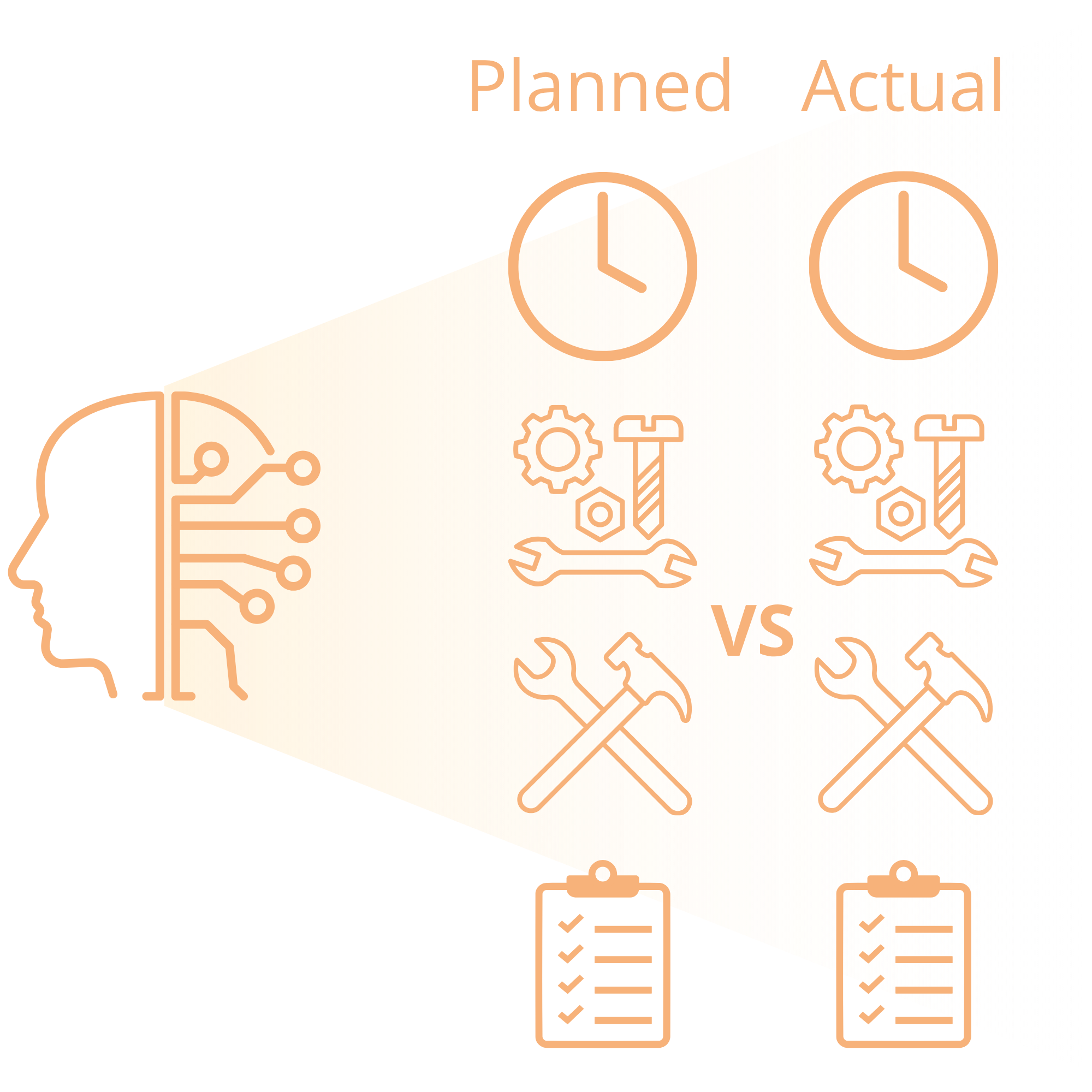
The analysis is performed intelligently via SAP BTP AI Core in direct integration with SAP FSA.
Instead of generating a generic questionnaire, the AI dynamically selects two to five highly relevant questions from a structured question library — tailored precisely to the specific use case.
For example, a technician is only asked about replacement parts if unplanned materials were used.
SAP Field Service & Asset Management and SAP Business Technology Platform as technological foundation
The solution integrates seamlessly into the activity closure workflow of SAP FSA and can be used directly in the field via a mobile web form.
The architecture at a glance
This results in a fully integrated end-to-end solution for intelligent service optimization.
This is particularly important for regulated industries: All AI decisions and feedback processes remain transparent, traceable, and documented in an audit-proof manner.

Real-world example: How the AI assistant works in field service
A service technician takes 2.5 hours longer than planned to complete a job. In addition, he installs an unplanned replacement part and leaves one checklist item open.
A traditional process would now trigger a lengthy standard questionnaire. The AI assistant, on the other hand, identifies exactly which deviations are relevant and asks only four targeted questions, such as:
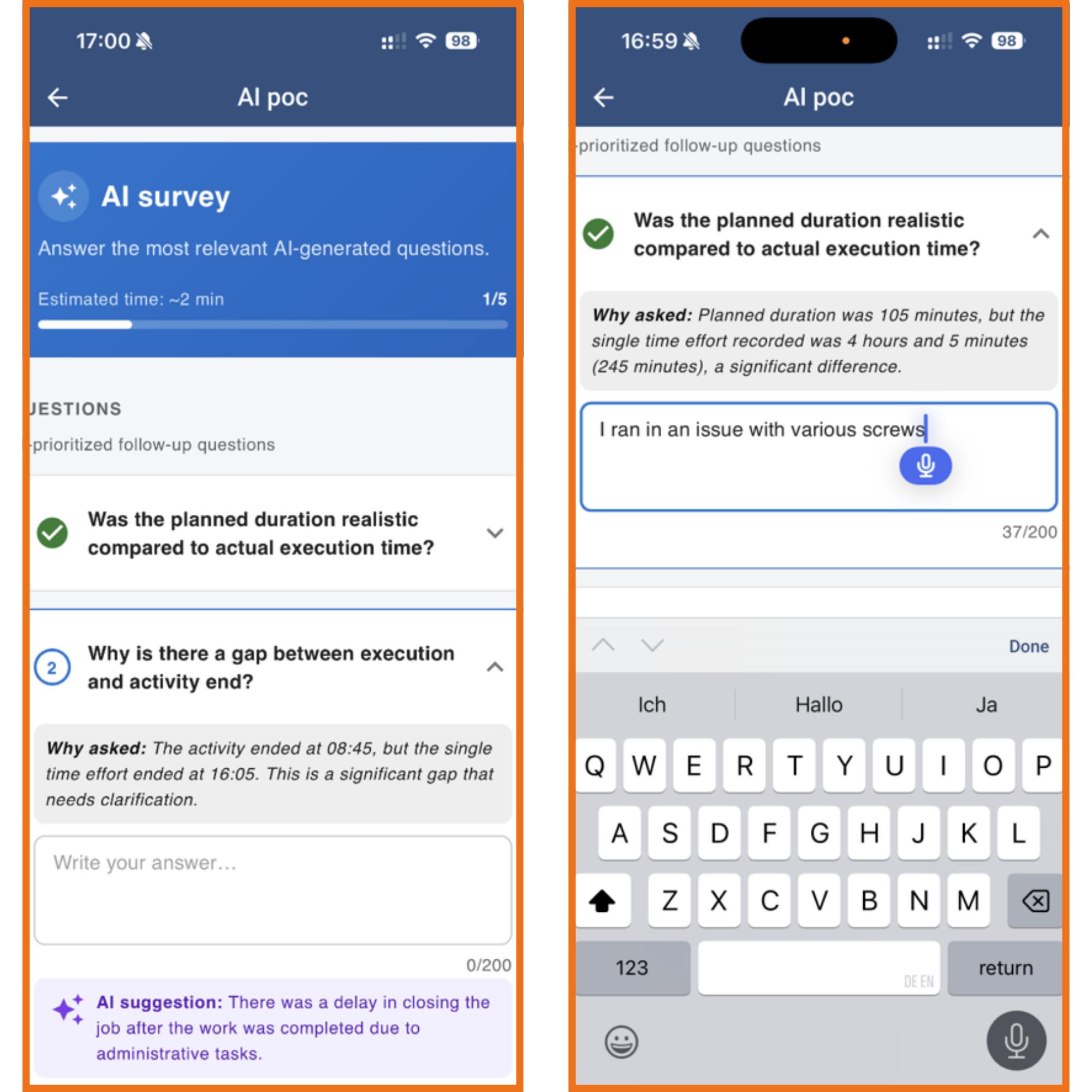
The responses are automatically classified and transferred directly back to SAP FSA. And from there, they can be further analyzed and transferred to a knowledge base.
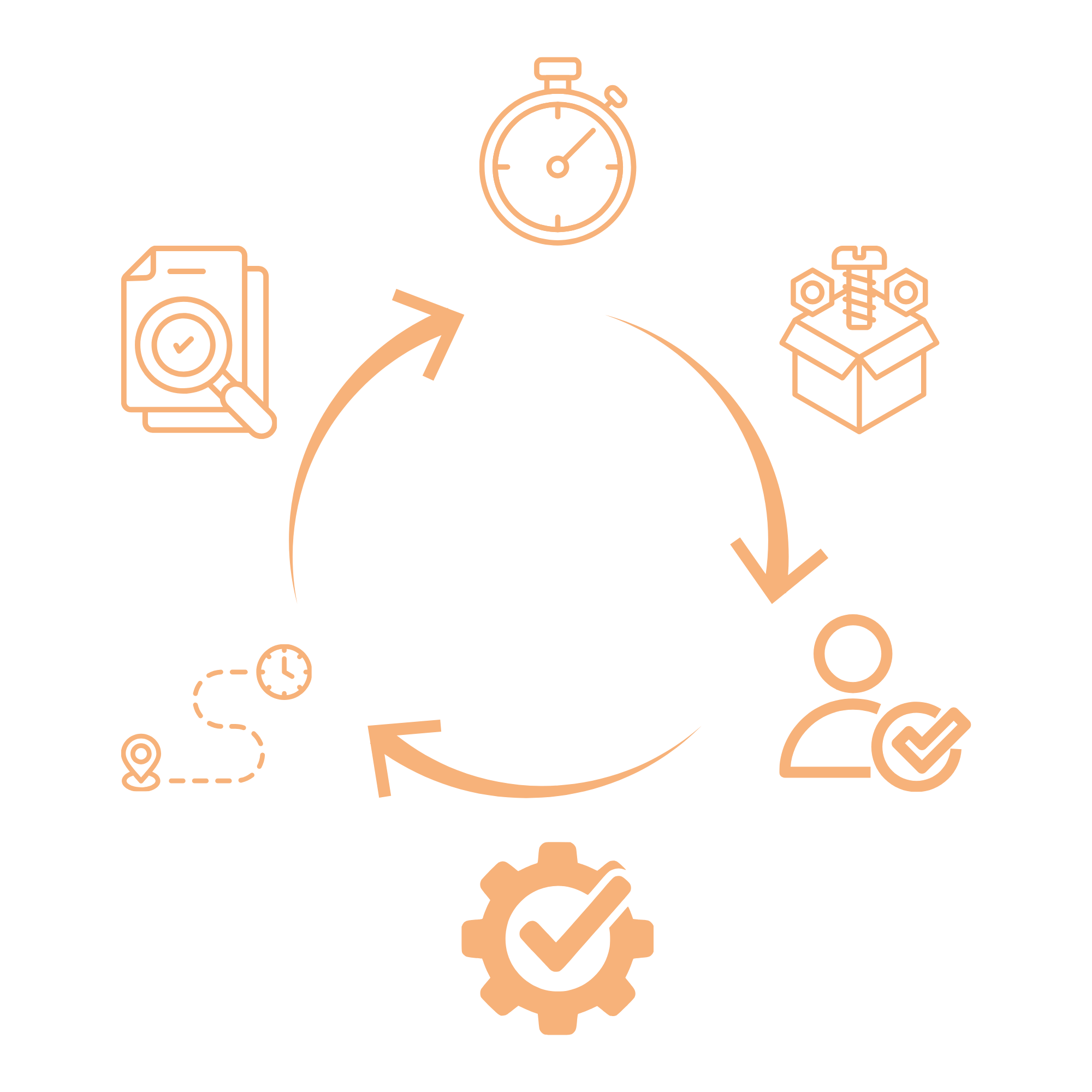
Continuous optimization of service planning
The greatest added value comes from intelligently incorporating these insights back into service processes.
Among other things, the data collected enables:
After just a few hundred feedback responses, statistical patterns emerge that enable a considerable optimization of the service organization.
AI in field service increases acceptance among technicians

A decisive factor in the prototype’s success is its easy-to-use design. Limiting the questions to a few context-specific ones ensures:
The technician is not burdened with unnecessary data entry but instead provides exactly the information needed to improve future assignments.
Voice-based AI assistant as the next stage of development
The next phase of development is already in the works:
Technicians can already enter their feedback directly using natural language on their mobile devices — hands-free, on the go, and in multiple languages. In the future, a voice-based dialogue assistant will ask technicians questions directly, thereby replacing the current web form interaction.
As a result, the AI assistant in field service is evolving into an intelligent, dialogue-based companion for the entire service process.

Higher customer satisfaction through transparent service processes
Project statement
„The assistant doesn’t ask what we asked it — it asks what the field service visit revealed. That’s the key difference from everything we’ve used so far in field service feedback.“
 Dr. Jan Loehe, Head of CoE Customer Interaction, proaxia consulting group
Summary: AI assistants are becoming the norm in modern field service
The AI prototype we developed demonstrates impressively how artificial intelligence can be used in a meaningful and practical way in field service.
Through the intelligent analysis of planned-versus-actual deviations, the dynamic generation of relevant questions, and direct feedback into SAP FSA, a learning service ecosystem is created that continuously improves itself.
For companies, this means:
SAP FSA, SAP BTP AI Core, and SAP AI Launchpad together lay the foundation for the next generation of intelligent service organizations.

FAQ – AI Assistant Field Service
Take the next step now
If you want to digitize and sustainably optimize your service processes, it is worth taking a look at modern solutions in the field of field service & asset management software.

Your expert

Dr. Jan Loehe
Head of CoE Customer Interaction, proaxia consulting group
Dr. Jan Löhe has been advising global companies on the digital transformation of their sales and service processes for over 20 years – with a deep understanding of B2B customer interaction in the mechanical and plant engineering, medtech and high-tech industries. At proaxia, he is responsible for the Center of Excellence “Customer Interaction” and the proaxia Customer Service Suite (CSS) and drives the practice-oriented implementation of integrated solution architectures, SAP CX solutions and Business AI.