AI in Customer Service
Less Typing, More Solving:
Across Six Use Cases

AI in customer service is no longer a project for the future — it’s an operational reality. Using six specific use cases, this article demonstrates how Business AI in SAP Service Cloud is transforming service processes in the mechanical and plant engineering industry: for help desk agents, technical support, service back office, and team leaders — not as a promise for the future, but as functionality that can be activated today.
Why AI Is Crucial in Customer Service Now — Not Tomorrow
The market has crossed a threshold. While just a few years ago AI in customer service was discussed as a strategic topic for the future, it has already become an operational reality for a growing number of companies. Three key figures clearly illustrate the urgency to act:
These figures do not reflect a trend — they reflect a shift in the competitive landscape. Companies that remain in evaluation mode today are wasting time that cannot be recovered.
The key point here is that AI in customer service amplifies what’s already in the system. Incomplete master data, a lack of system integration, or unclear process responsibilities aren’t masked by AI — they’re amplified. Those who secure their data foundation now through integrated processes — using SAP Service Cloud, SAP S/4HANA, and SAP Field Service & Asset Management (FSA) — will have a competitive edge in 12 months that will be measurably evident. proaxia lays this foundation with its Seamless Service approach.
AI in a Mechanical Engineering Company’s Customer Service — A Day in the Life of Customer Service
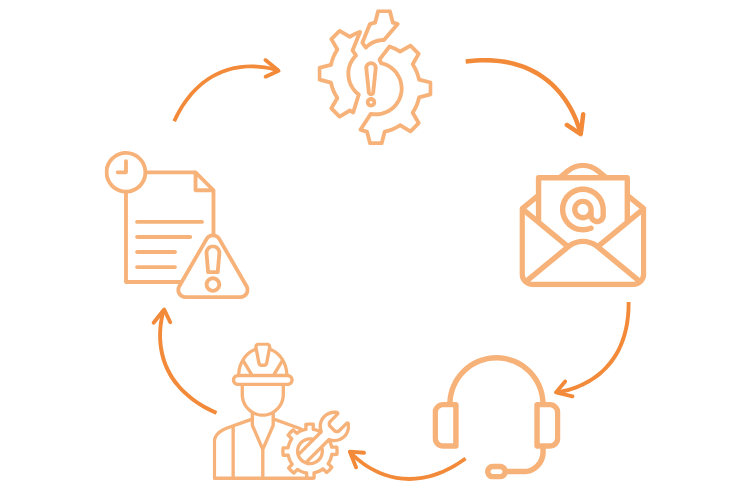
It is Monday morning, 7:45 a.m. The production manager of a medium-sized plant engineering company sends an email to the service desk of a machine manufacturer. The plant is operating with increased wear and tear; the fault cannot be clearly classified, and the urgency is high.
In the past, this is where a familiar sequence of events would begin: reading the email, forwarding it internally, identifying the person in charge, manually creating a report in the system, and selecting an error classification from the catalog — a process that could take hours. While the customer waits, the system is down, and trust is lost.
With AI in customer service powered by SAP Service Cloud V2, this Monday is shaping up to be fundamentally different.
Scenario 1
Input: AI automatically handles the preliminary work
Even before an employee opens the email, the service case has already been fully created. AI-powered automation in customer service analyzes the incoming message, independently identifies the case type and category, maps the customer number and the affected equipment from the ERP master data, and assigns a priority — based on historical patterns, not manually maintained rules. At the same time, the AI evaluates the tone of the inquiry: The message indicates a high level of urgency. The case appears in the queue with the appropriate priority — visible to the entire service desk even before anyone has responded.
What this means for the help desk agent: They don’t start their workday with an unsorted inbox that they have to prioritize manually. Instead, they find a pre-structured, fully documented overview — sorted by urgency and assigned to the correct context. What used to take 5 to 10 minutes of administrative work per incoming message is now completely eliminated. The right contact person can respond immediately without having to go through the hassle of forwarding emails.
And for the service team leader, this means: He can see in real time on his dashboard that a critical case has come in — and can take immediate action without having to wait for the next team meeting.

Scenario 2
Assignment: Intelligent Routing Instead of Manual Dispatching

Who should handle this case? In the reality of equipment-intensive service organizations, this question is not trivial: A service desk with multiple product specialists, varying workloads, and a request that may involve several departments — this requires the kind of judgment that has traditionally relied on experienced staff.
The AI in the service process handles exactly this assessment: based on the case type, the machine class, the contractual SLA status, and the team’s current capacity situation. The case is assigned directly and accurately — without detours, without delays, and without the misassignments that manual dispatching inevitably produces.
What this means for the team leader: Manual dispatching is no longer a daily task. And he is no longer a bottleneck between incoming messages and processing. Instead, he can monitor the quality of processing, intervene in escalated cases, and provide targeted development for the team.
Scenario 3
Execution: AI as a Reliable Partner to Specialists
The hydraulic specialist from Technical Support opens the assigned case. What the SAP Service Cloud AI provides at that moment is the real productivity gain: a fully prepared case summary — case history, actions taken so far, customer sentiment assessment, and communication history across all channels. No need to click through various tabs — just a structured, action-oriented overview of the situation.
Even if the technical specialist hasn’t worked with this customer before, or if the case is taken over after a shift change — they’ll be fully up to speed within seconds. The training period that used to accompany every handoff in B2B service environments with complex machine histories is no longer necessary.
At the same time, the specialist can see how similar cases were resolved in the past. The AI does not recommend generic measures, but rather historically proven approaches — filtered by case description, machine type, and classification from the company’s own service history. If the specialist needs to reply to the customer, the “Email Draft Recommender” provides a context-sensitive draft response: tailored to the customer’s communication style, the SLA and case status, and the specific circumstances of the case. What used to take 10 minutes to draft now takes just 2 minutes to review.

Scenario 4
Troubleshooting: Expert Knowledge at Your Fingertips

Not every service case can be resolved with an email using a pre-written response template. When a technical problem requires deeper analysis, Technical Support needs quick access to precise information: What has caused this error code in this machine class in the past? Which solutions have worked — and which haven’t? Is there a current service bulletin?
In the past: opening various systems, trying out search terms and filters, manually reviewing results, and filtering out relevant information. With “Intelligent Q&A” in SAP Service Cloud, specialists can ask their questions in natural language — and receive a direct, context-sensitive answer from the company’s own knowledge base. No more scrolling, no more guessing, and no more knowledge that exists in the system but can’t be found.
In organizations in the mechanical and plant engineering or medical technology sectors with a high proportion of experienced service technicians nearing retirement, this point is particularly relevant from a strategic perspective: Critical product and customer knowledge is now embedded in completed service orders. AI in customer service makes this knowledge accessible — to every employee, regardless of their level of experience, product knowledge, or length of service.
Scenario 5
Conclusion: Every case solved improves the next one
As soon as a case is resolved, a process begins that is often missing in manually operated service organizations: the systematic documentation of the solution path for future cases. Knowledge databases don’t become outdated because no one has the knowledge — but because no one can find the time to document it after a full day of service.
The “Knowledge Creation Agent” in SAP Service Cloud automatically detects when a case has been successfully closed, extracts the relevant solution, and prepares a structured knowledge article—ready for use, with no manual effort required. The service back office focuses on quality assurance, content development, and targeted approval. The knowledge base grows with every closed case—systematically and without requiring additional staff resources.

Scenario 6
Control: What the Team Leader Really Needs to See

What the team leader sees at the end of a service day is not a manually compiled weekly report based on Excel exports and system queries. It’s a real-time snapshot of their service organization: first-call resolution rate, average handling time, SLA compliance, and satisfaction trends across all customer interactions over the past weeks and months — all at a glance, without any additional processing.
The AI-powered “Case Topic Analyzer” in SAP Service Cloud takes it a step further: It visualizes which topics and error patterns are recurring — not as a table of raw data, but as interpretable word clouds and trend charts. If a specific error code occurs repeatedly for a particular machine class, this becomes apparent before it triggers a wave of escalations. This gives the team leader the lead time needed to act proactively: prioritize cases, reallocate resources strategically, and proactively inform affected customers.
This represents a fundamental shift in the understanding of management: away from a reactive response to complaints, toward proactive management based on signals that the system itself detects and makes visible.
AI in Customer Service: Benefits by Role — and Measurable Results
AI in customer service with SAP Service Cloud is not a collection of isolated, standalone functions. It is a comprehensive transformation of the service process — from incoming inquiries through diagnosis and resolution to the systematic use of knowledge and proactive management. Every user role benefits at the points relevant to them:
Three real-world benchmarks illustrate the potential that AI can unlock in customer service with SAP:
Take the next step now
proaxia activates, integrates, and scales these functions — tailored to the process realities of companies in mechanical and plant engineering, medical technology, and the high-tech sector and related industrial sectors.
Your expert

Dr. Jan Loehe
Head of the Center of Excellence for Customer Interaction, proaxia consulting group
For over 20 years, Dr. Jan Löhe has been advising global companies on the digital transformation of their sales and service processes — drawing on his deep understanding of B2B customer interaction in the machinery and plant engineering, medtech, and high-tech industries. At proaxia, he oversees the “Customer Interaction” Center of Excellence and the proaxia Customer Service Suite (CSS), and drives the practical implementation of integrated solution architectures, SAP CX solutions, and Business AI.